French Ministry of Education (via Six Red Marbles)
75+ VR training modules, one shared delivery system
A government-backed vocational education programme spanning healthcare, childcare, energy, mobility and industrial safety.
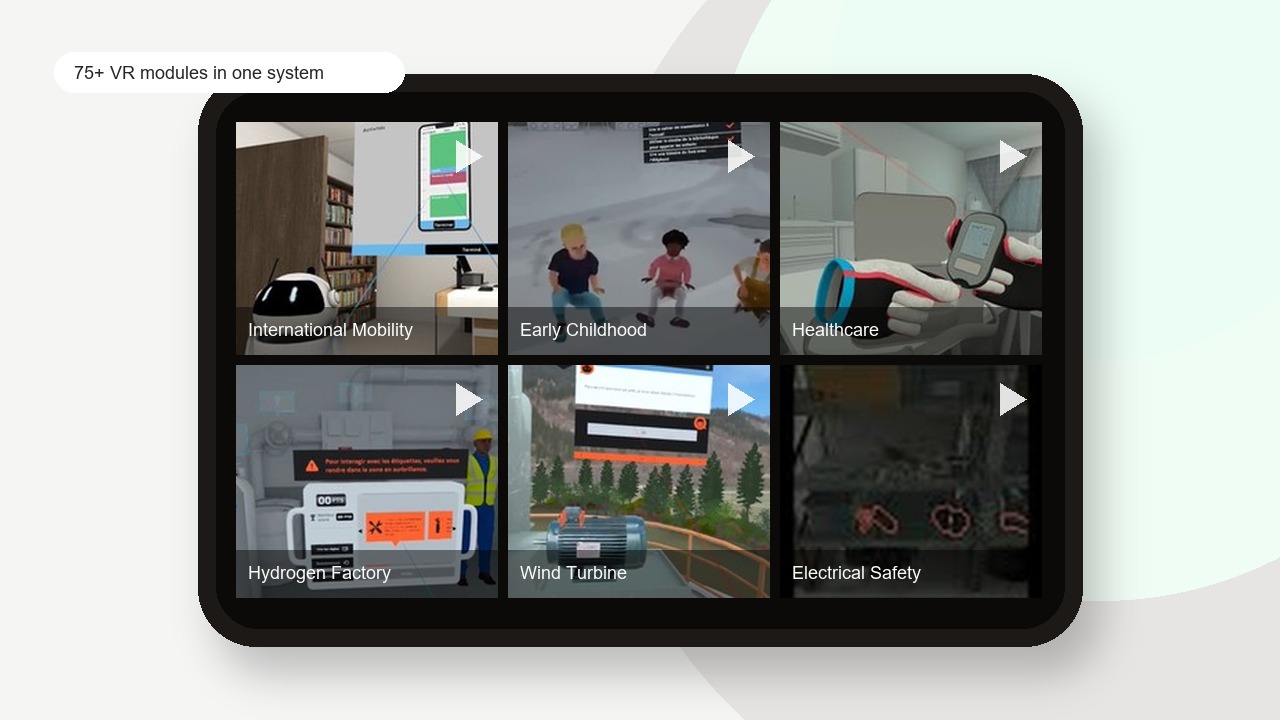
// Featured Module Demo Videos
Cultural readiness training where learners plan schedules, understand norms, coach peers and rehearse everyday decisions before studying or working abroad.
Nursery-care simulation for daily routines, child interaction, storytime activities and observation-based intervention in a safe, repeatable classroom environment.
Clinical workflows covering patient interaction, hygiene protocol, safe handling and blood-glucose checks, including the dedicated VR Glucometer Training module.
Industrial safety training with card-memory recall, CCTV hazard spotting, ATEX label reconstruction and 3D drag-and-drop hazard identification.
Tool-based maintenance simulation for inspection workflows, safety sequencing, diagnostic thermal-camera use and equipment securing under manufacturer guidelines.
Corrective maintenance inside a windmill workshop, with lockout/tagout, risk awareness and hands-on rehearsal for high-stakes electrical safety procedures.
The context
A national vocational-education programme under the French Ministry of Education needed VR training at library scale: not one showcase module, but 75+ practical simulations covering healthcare, childcare, hydrogen-factory operations, wind-turbine maintenance, international mobility and industrial safety. The programme ran across multiple years and teams, with Six Red Marbles India joining the effort to scale the Hospital and Hydrogen Factory domains while aligning with work already underway in Romania.
The challenge
At 75+ modules, a "build every module separately" approach collapses under its own maintenance cost. Every scenario needed a consistent starting flow, tutorial, control grammar, scoring model, desktop fallback and LMS reporting. Two teams also needed to work in parallel without creating slightly different implementations of the same behaviour. A shared bug needed one fix, not 75 fixes. A release needed an automated pipeline, not a week of manual builds.
Why UltimateXR
We chose UltimateXR over Unity's default XR Interaction Toolkit because the programme needed realistic hand presence and highly repeatable implementation patterns across dozens of repositories.
- —Rigged hand models — The healthcare and tool-use modules depended on believable fine-motor interaction, from glucose meters to maintenance tools.
- —Programmatic interactions — More logic in C# meant behaviour could be versioned, reviewed and shared across modules instead of being buried in scene Inspector settings.
- —Lower merge friction — A smaller Inspector footprint reduced prefab and scene conflicts, which matters when multiple teams ship in parallel.
The custom framework
The real deliverable was not just the module count; it was the shared framework that made that count sustainable. We architected the common layer as a Git submodule, so every training repository pulled core behaviours from one source of truth.
The framework handled:
- —Starting scene — a common entry point across all modules with consistent branding, language selection and session initialisation.
- —Tutorial scene — a shared onboarding experience teaching VR controls and interaction patterns, so learners only needed to learn VR once.
- —Common functionality — scoring, progress tracking, step validation, UI overlays and hand interactions propagated across the programme via the submodule.
- —PC Compatibility mode — a desktop fallback so learners without headsets could complete the same training using keyboard and mouse.
- —Moodle LMS integration — score reporting, completion tracking and learner analytics piped into the institution's existing LMS.
Deployment
Primary deployment targeted Meta Quest 2, with validation on Quest 3. Every module also produced a PC Compatibility build for keyboard and mouse, so learners without headset access could still complete the same training. GitHub Actions automated the build process for VR and desktop targets, while Moodle integration handled score reporting, completion tracking and institutional learner analytics.
What shipped
A library of 75+ VR modules spanning multiple vocational domains, with six representative demos shown above: international mobility, early-childhood care, healthcare, hydrogen-factory safety, wind-turbine inspection and electrical safety. Alongside the modules, the programme shipped a reusable framework, automated build pipeline, PC fallback mode and Moodle LMS reporting.
The outcome
Per-module effort dropped because teams built the domain-specific scenario instead of rebuilding the training shell. Two teams could ship in parallel while keeping learners inside a consistent system: same onboarding, same control grammar, same scoring expectations and same release pipeline. The framework turned a 75+ module programme from a collection of one-offs into a maintainable product line.